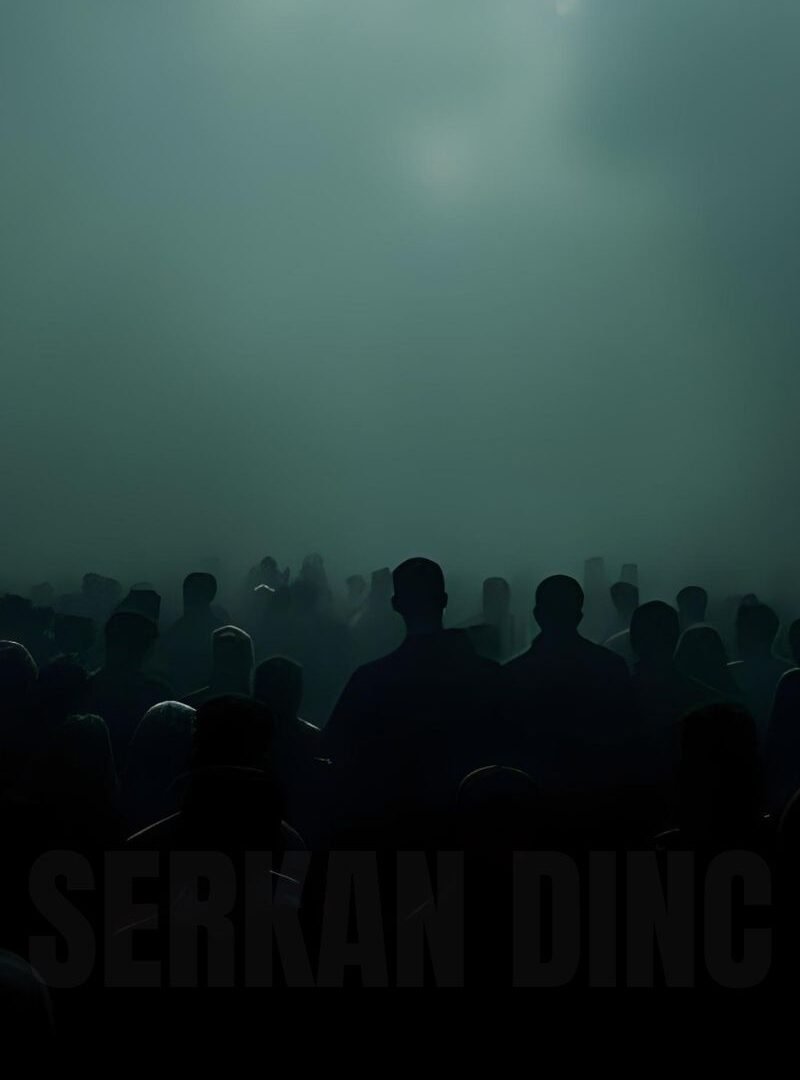
How Visual Noise Reshapes Our Ability to See**
By Serkan Dinç – 2025
(~1150 words)
We live in an era defined by an unprecedented explosion of visual material. Every day, billions of images are produced, filtered, circulated, and discarded within hours. This relentless production has become so naturalized that we rarely ask the simplest question: What happens to our ability to see when we are surrounded by too much?
The term “visual noise” has slowly entered cultural theory, but it remains inadequately examined within the context of contemporary art. Visual noise refers not merely to the excess of imagery but to the psychological saturation that follows—the inability to distinguish what deserves attention from what is engineered to steal it.
In this environment, seeing becomes a compromised act.
Seeing used to involve contemplation, distance, silence.
Now it involves scrolling, reacting, forgetting.
The tragedy is that the human brain was never designed for this volume of visual input. We have become spectators of an endless flood, and in doing so, we lose the capacity to perceive depth. Images, once rare and precious, have become disposable.
Art historically relied on a particular scarcity. Most people did not encounter meaningful images daily. The few they did see—religious icons, frescoes, portraits, architectural reliefs—held symbolic weight. They structured emotional, spiritual, and social life. The scarcity of images gave them power.
But today, scarcity has been replaced by excess.
The image is no longer an event; it is wallpaper.
This change produces a subtle violence. When everything demands attention, nothing receives attention.
This is the first wound visual noise inflicts:
it collapses the hierarchy of meaning.
In a saturated environment, the most profound artwork and the most trivial meme occupy the same level of perceptual importance. They appear within the same feed, the same rhythm, the same speed of consumption. The viewer is unable to slow down enough to recognize difference.
And when difference collapses, art loses its ability to interrupt.
Throughout art history, interruption was essential. A painting or sculpture interrupted ordinary perception—it forced the viewer to pause, to reconsider, to feel. Interruption created the conditions for transformation. But in an environment dominated by visual noise, the artwork cannot interrupt because the viewer is already overwhelmed. Aesthetic overload produces emotional numbness.
The second wound visual noise inflicts is even more insidious:
it alters the emotional architecture of perception.
When we are constantly exposed to visual stimuli, our threshold for impact rises.
We crave stronger colors, sharper contrasts, more dramatic compositions—not because we desire them aesthetically, but because the nervous system demands them for stimulation.
Subtlety becomes invisible.
Quiet images become mute.
This explains why so much contemporary commercial imagery adopts exaggerated palettes, intense saturation, hyperreal effects. These images are designed to survive in a noisy environment, not to speak meaningfully.
They must shout to exist.
But art has never been about shouting.
Art has been about resonance—about the slow echo that remains after the initial encounter.
The quietest artworks in history—Vermeer’s interiors, Morandi’s still lifes, Rothko’s color fields—are powerful precisely because they resist noise. They cultivate silence within the viewer.
Yet silence is now a foreign language.
This leads to the third wound:
the viewer loses the capacity for introspection.
Visual noise does not simply affect external perception; it erodes inner space.
The mind becomes unable to register subtle emotional shifts.
The internal world becomes fragmented, flattened, accelerated.
What disappears is not merely attention but depth—the depth required to experience art on its own terms.
Depth requires vulnerability.
It requires slowing down.
It requires letting an artwork disturb your interior rhythm.
But in a visually saturated culture, our rhythms belong to the algorithms that feed us.
This transformation is not a psychological inconvenience—it is a cultural crisis.
Art is one of the few remaining spaces where slowness, ambiguity, and emotional uncertainty are not only allowed but essential. But when visual noise becomes the dominant mode of perception, even art begins to adapt.
Exhibitions shift toward immersive digital rooms, spectacle-driven installations, and fast-impact visuals.
Museums compete with entertainment industries.
Artists feel pressure to be visually “loud.”
But loudness is the opposite of meaning.
Meaning whispers.
Meaning needs space.
Meaning cannot be consumed in seconds.
The survival of art depends on the preservation of this space.
So what must change?
Certainly not the existence of images—we cannot and should not return to a pre-digital world. The problem is not technology but rhythm. Not abundance but acceleration.
Artists today face a profound challenge:
How can art create silence within a world that fears it?
Silence is not emptiness; it is the condition of perception.
It is the backdrop against which meaning emerges.
Without silence, an artwork cannot breathe.
Without silence, a viewer cannot feel.
The artist of today must therefore become a practitioner of silence. Not literal silence, but perceptual silence—art that slows the viewer, redirects attention inward, interrupts the rhythm of digital culture rather than contributing to it.
This does not mean ignoring technology; it means resisting its default tempo.
It means using visual language in ways that cultivate depth rather than noise.
It means valuing nuance over spectacle, ambiguity over clarity, stillness over speed.
In this sense, art becomes a form of resistance—a resistance not against technology but against the velocity with which technology shapes perception.
We do not need fewer images;
we need better ways of seeing.
And seeing is not a passive act.
Seeing is a discipline.
Seeing is a form of care.
When we learn to see again, art regains its transformative power.
And when art regains its power, the human spirit regains something it did not know it had lost:
the ability to feel itself thinking.
The world will continue to drown us in images.
But the artist’s task—the urgent, impossible, necessary task—is to build islands of perception within that flood.

Serkan Dinç
Ceramic artist and production technician sharing insights from the studio.