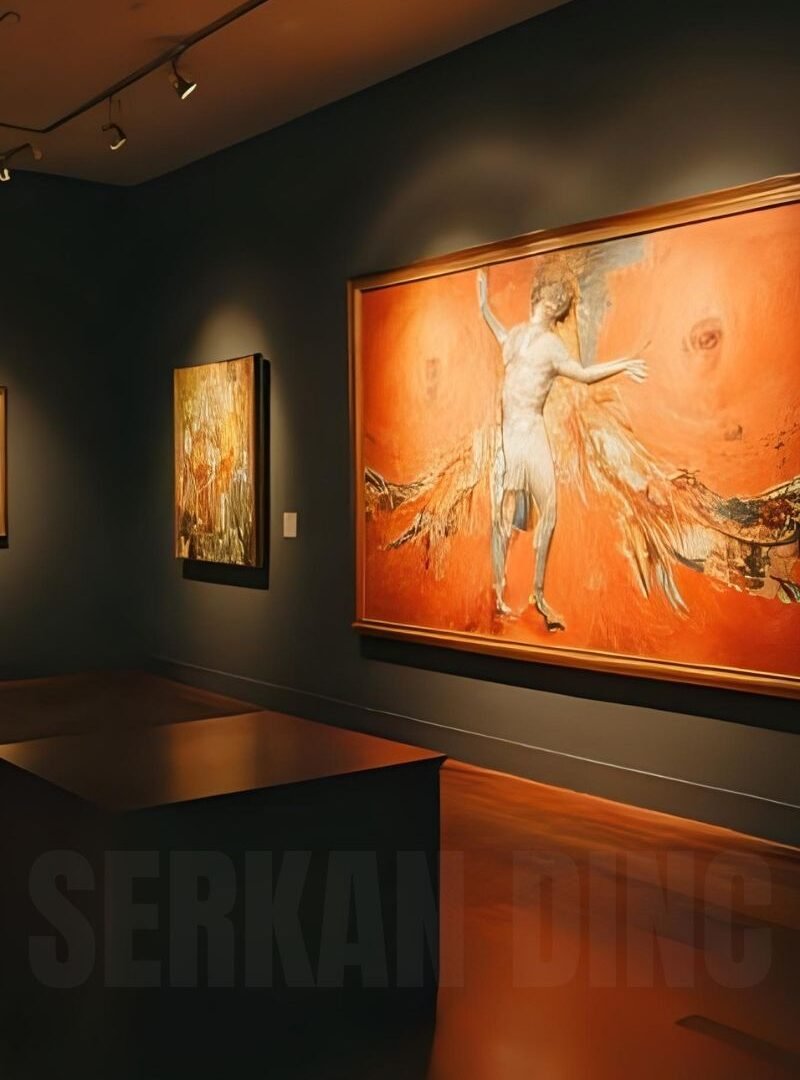
The New Loneliness of the Contemporary Artist**
By Serkan Dinç – 2025
If one were to describe the emotional landscape of contemporary artistic life in a single sentence, it would be this:
never have artists been so visible, yet so profoundly alone.
This paradox defines the cultural condition of our time. Artists broadcast their work to global audiences, maintain active profiles on multiple platforms, engage in digital communities, and measure visibility through likes, impressions, and reach. Yet this hypervisibility—often mistaken for connection—has created a new form of emotional isolation.
To understand this loneliness, we must examine the difference between visibility and intimacy.
Visibility is external; it requires exposure, performance, and constant engagement.
Intimacy is internal; it requires vulnerability, slowness, silence, and genuine connection.
These two states are fundamentally incompatible in contemporary digital culture.
The artist, once defined by solitude, now lives in public. The studio—historically a sanctuary for introspection—has become an extension of the social stage. Works in progress are documented. Moments of doubt are shared. The private struggle that once shaped artistic identity has been replaced by performative transparency.
This transformation produces an emotional contradiction:
artists must be accessible to be relevant, yet they must be alone to be creative.
The first injury of visibility is that it commodifies presence.
An artist can no longer simply exist—they must be available, responsive, communicative.
Their identity becomes a form of content. Their silence is interpreted as decline. Their absence is treated as failure.
This creates a psychological condition in which the artist is always “on,” always anticipated, always observed. Even the internal world becomes externalized through narratives, captions, updates, and statements.
But art does not emerge from constant availability.
Art emerges from withdrawal.
Historically, the artist’s solitude was not romantic isolation; it was functional necessity.
Solitude allowed the mind to wander, to doubt, to process emotional turbulence, to sit with contradictions.
Creativity requires uninterrupted interior time—a space where the psyche can unfold without expectation.
Visibility disrupts this space. It accelerates the mind. It fractures attention.
And the artist begins to feel a new kind of loneliness:
not the loneliness of absence, but the loneliness of overexposure.
This is the second injury:
visibility erodes the inner life it claims to celebrate.
The more an artist reveals, the less they possess privately.
The more they articulate, the less they feel.
The more they perform themselves, the less they know themselves.
The digital era replaces introspection with self-presentation.
The artist begins to live outside-in instead of inside-out.
Identity becomes something to curate rather than discover.
This creates a sense of emotional dislocation:
the artist becomes visible but not known, expressive but not understood, connected but not held.
And this leads to the deepest wound:
the modern artist becomes lonely within their own identity.
Existential psychology describes this condition as “alienation from the self”—a state in which the individual feels disconnected from their own emotional truth because they are too entangled in external expectations.
For artists, this alienation is particularly dangerous.
Art requires authenticity—not the superficial authenticity sold in contemporary culture, but existential authenticity: the willingness to confront one’s own interior world without performance.
When identity becomes externalized, authenticity becomes performative.
And performative authenticity cannot produce transformative art.
But why has visibility become such an obligation?
Because contemporary systems reward it.
The attention economy demands constant presence.
Platform algorithms reward frequency over depth.
Audiences expect engagement, clarity, consistency.
Silence is punished; slowness is misunderstood.
The culture pushes artists into a continuous loop of creation, sharing, responding, updating.
Yet the human psyche was not designed for continuous exposure.
Emotional resilience erodes.
Creative intuition numbs.
The inner world becomes thin, overstretched, exhausted.
This produces a strange emotional condition:
the artist becomes surrounded by people and yet has no one to share the real self with.
Connections become transactional.
Critiques become public.
Success becomes visible.
Failure becomes humiliating.
Intimacy becomes rare.
Even other artists, navigating the same pressures, struggle to offer genuine companionship.
Community becomes competition disguised as support.
Solidarity becomes performative.
Isolation becomes normalized.
But the loneliness of the contemporary artist is not only social—it is also structural.
Modern culture has eliminated the psychological spaces necessary for introspection.
Silence is perceived as inefficiency.
Withdrawal is perceived as disappearance.
Slowness is perceived as irrelevance.
Yet creativity operates on a fundamentally different rhythm.
It requires the kind of time that cannot be accelerated.
It requires emotional depth that cannot be performed.
It requires internal coherence that cannot be gained through external validation.
Thus, the artist must cultivate a countercultural stance.
Not through rebellion, but through reorientation.
The artist must reclaim:
– solitude without shame
– silence without fear
– inwardness without guilt
– privacy without apology
These are no longer luxuries; they are survival strategies.
The future of meaningful art depends on the preservation of interiority.
This might require new forms of creative practice—rituals of disconnection, intentional boundaries, pockets of silence where the artist can retreat from the noise of visibility.
It might require new forms of community—spaces built on genuine exchange rather than performance.
It might require a new understanding of success—measured in depth rather than reach, in transformation rather than engagement metrics.
What is certain is this:
if artists lose their inner world, the world loses its art.
Visibility can offer opportunity, but only intimacy can offer meaning.
An artist who is never alone can never truly create.
And perhaps this is the essential truth of the digital age:
the greatest risk to the artist is not obscurity—it is exposure.
Not the absence of audience, but the erosion of self.
Not solitude, but the inability to access solitude.
To protect the inner life is to protect the source of art itself.
In the end, the contemporary artist must reclaim what visibility has stolen:
the right to be unseen.

Serkan Dinç
Ceramic artist and production technician sharing insights from the studio.