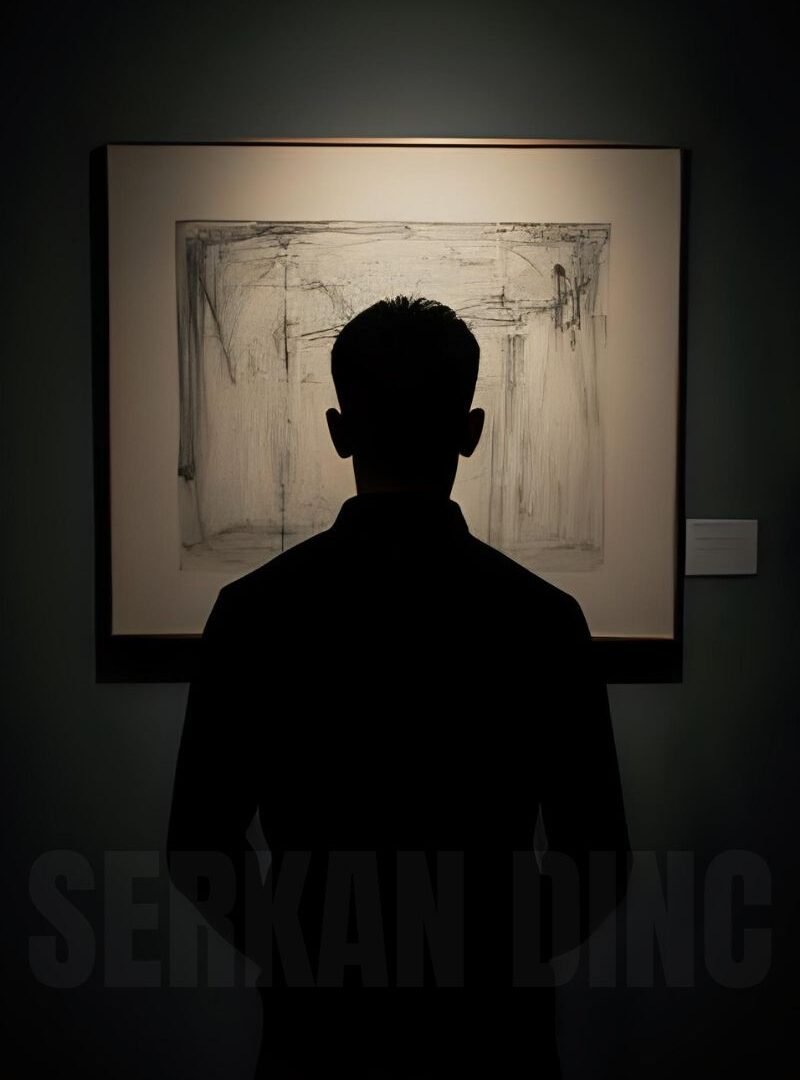
Why Meaning Begins Where Explanation Fails**
By Serkan Dinç – 2025
(~1150 words)
We live in a culture obsessed with explanation. Everything must be justified, articulated, interpreted, made accessible. Even art—once valued precisely for its ambiguity—has become burdened by an endless chain of curatorial texts, academic commentaries, guided tours, QR codes, podcasts, and interpretive panels.
It is as if the artwork is no longer allowed to stand on its own.
But art has always belonged to the realm of the untranslatable.
This does not mean art is incomprehensible. It means that its meaning does not submit to the logic of direct verbalization. It emerges in the space between seeing and feeling, between the artwork’s presence and the viewer’s interior world.
To insist on explaining art is to misunderstand the nature of meaning itself.
Art’s meaning is not delivered—it is negotiated.
The viewer does not receive a message; they encounter themselves through the artwork.
Thus the question is not “What does this artwork mean?”
but “What does this artwork do to me?”
This distinction is foundational.
An artwork is not a container of fixed information. It is a catalyst for experience. Its meaning is not inherent; it is relational. It arises through the tension between the visible and the invisible—the seen image and the unseen response it awakens.
To analyze this dynamic, we must turn to aesthetics and phenomenology.
Phenomenology teaches us that perception is never neutral.
We do not approach an artwork from a blank state; we bring with us memory, desire, history, trauma, expectation, projection. Meaning is formed through the interplay of these forces.
This is why an artwork changes each time we see it—because we change.
The insistence on explanation assumes that meaning is an object, stable and retrievable.
But meaning is a process, alive and unstable.
This is the first error of over-explanation:
it treats art as if it were a form of information rather than a form of experience.
Consider Rothko’s color fields.
They do not “represent” anything.
They simply exist—large, vibrating planes of color.
Viewers often cry in front of them.
Not because they understand them,
but because they allow themselves to be altered by them.
No explanation can produce that.
Explanations may accompany, enrich, contextualize.
But they cannot substitute the encounter.
And yet, contemporary institutions increasingly act as if explanation is required to legitimize art.
This trend has emerged for several reasons:
- Institutional anxiety: museums fear the audience will feel lost.
- Market-driven clarity: collectors want justification for value.
- Academic dominance: theory overshadows experience.
- Digital habits: viewers expect immediate comprehension.
But art does not belong to immediacy.
Art belongs to duration.
To uncertainty.
To vulnerability.
The second error of explanation is that it pre-conditions perception.
When a viewer encounters an artwork with a lengthy text next to it, they are already directed toward specific interpretations. Their gaze is constrained. Their freedom is limited.
Explanation becomes a filter that separates the viewer from the work instead of connecting them to it.
Meaning becomes inherited rather than discovered.
This raises a deeper philosophical issue:
Why do we feel the need to explain art at all?
The desire for explanation stems from our discomfort with ambiguity.
Ambiguity is disruptive.
It forces us inward.
It destabilizes our intellectual control.
Art confronts us with the limits of our own understanding—and modern culture resists anything that resists mastery.
But ambiguity is not confusion.
Ambiguity is spaciousness.
It allows for multiple interpretations, multiple emotional states, multiple narratives.
Ambiguity is freedom.
An artwork with a single interpretation is not art—it is propaganda.
This leads us to the third and most important error of explanation:
over-explaining art reduces its existential power.
Art’s power lies in its ability to destabilize.
To provoke introspection.
To confront us with ourselves.
Explanation domesticates that power.
It turns a radical encounter into a controlled experience.
This is why the most impactful moments with art often occur in silence. Silence creates the conditions for perception to deepen. It slows us down. It forces us to feel rather than analyze.
In silence, the artwork breathes.
Consider the experience of entering a quiet gallery alone.
The air is still.
The lighting is soft.
Your footsteps echo.
You stand in front of a painting without guidance, without instruction, without expectation.
Your mind is exposed to something unfamiliar.
This is the moment where meaning begins.
Meaning begins when the viewer is vulnerable enough to let the artwork operate on them.
Meaning begins in the internal shift that cannot be articulated.
Meaning begins where explanation fails.
The untranslatable nature of art is not a flaw—it is the source of its transformative capacity.
But what does this mean for contemporary artists?
In a world that rewards clarity, narrative, and explanation, artists must defend ambiguity.
Not as a form of elitism, but as a form of integrity.
Ambiguity protects the interiority of the work.
It keeps the artwork open, alive, and capable of evolving.
The contemporary artist must therefore become a guardian of ambiguity—
a practitioner of the untranslatable.
Not everything must be said.
Not everything must be revealed.
Not everything must be explained.
This does not mean that artists should avoid discussion.
It means they should distinguish between accompaniment and substitution.
An artist’s text can accompany the work without replacing it.
A curator’s essay can enrich the work without confining it.
A theoretical reflection can illuminate the work without determining it.
The danger lies not in writing about art, but in believing that writing is art.
Art is not language; it is presence.
Language can guide us to the threshold of experience, but it cannot cross it.
Only seeing can.
Only feeling can.
Only the encounter can.
And the encounter requires an open space—an interior silence unburdened by premature explanation.
In the end, the most important truth is simple:
Art is not meant to be understood; it is meant to be lived.
Meaning is not found in the artwork; it is found in the viewer who risks entering its silence.
Where explanation ends, art begins.

Serkan Dinç
Ceramic artist and production technician sharing insights from the studio.